
AI in Hospitality: From Thinking to Doing
Jan 26, 2026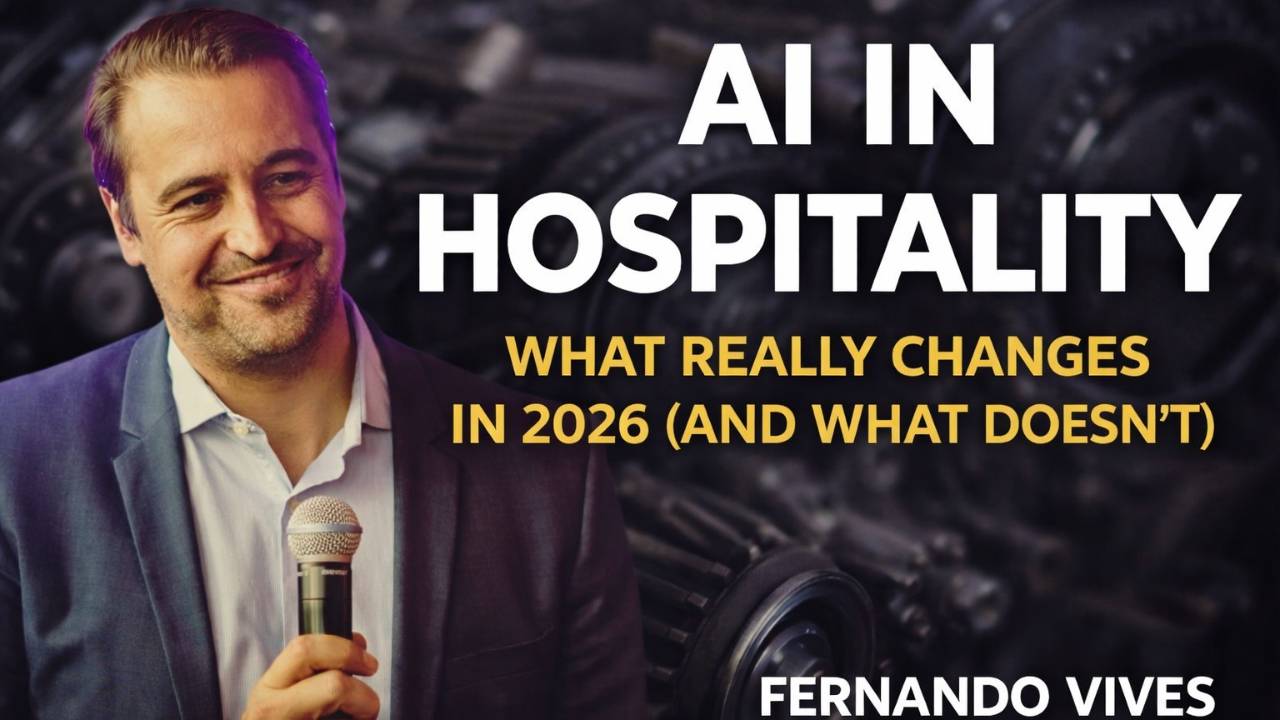
AI in Hospitality: From Thinking to Doing
The week of FITUR 2026, I had the opportunity to attend Google’s Travel event in Madrid, Spain. Not as a tourist of innovation—but as a practitioner. A room full of leaders. Big ideas. Sharp visuals. Powerful statements. And yet, walking out, one thought kept coming back:
The future is not about thinking more about AI. It’s about moving from “thinking” to “doing.”
That single slide summed it up perfectly. This article is not a summary of the event.
It’s what stayed with me after the lights went down. A reality check on what is actually changing—and what is not.
What’s changing in 2026 (for real, from my point of view)
1) Speed is now a strategic advantage
One message was clear: the organizations that win won’t be the ones with more data or more tools. They’ll be the ones who can decide faster, with confidence.
Forecasts. Prices. Targeting. Allocation. Same decisions as always—but at a different speed and scale.
In a world where volume is often guaranteed, value is increasingly at risk.
2) Personalization is no longer optional
We’re entering a phase where travelers expect:
-
contextual relevance
-
seamless journeys
-
proactive assistance
Not because it’s “nice.” Because that’s what every other digital experience already delivers.
This changes marketing, distribution, loyalty—and ultimately revenue quality.
3) AI becomes a transversal layer
One idea I strongly agree with: AI is not a department. It’s not a tool. It’s not a project.
It’s an enabler across the commercial engine:
-
forecasting
-
pricing
-
marketing efficiency
-
operations
When positioned correctly, it doesn’t replace teams.
It raises the floor of decision-making.
What’s NOT changing (and these are the traps)
1) AI won’t fix broken processes
If your commercial workflow is unclear, AI won’t bring clarity.It will simply automate confusion. Technology accelerates whatever system you already have—for better or worse.
2) Tools don’t create value. Decisions do
We saw impressive demos. But value only appears when insights change behavior. No adoption, no impact. No ownership, no results.
3) Volume thinking is still dangerous
One slide stuck with me: “Volume is vanity. Yield is sanity.” In many markets, demand will continue to flow. The real challenge is protecting value, margin, and mix. That requires discipline—not dashboards.
4) AI won’t align your teams
If Sales, Marketing, and Revenue are misaligned today, AI will not magically bring harmony. Alignment is still a leadership decision.
The real opportunities (where AI actually pays)
From everything discussed, three areas clearly stand out:
1) Forecasting
Not perfection. But earlier signals, better scenarios, faster course correction.
2) Pricing
Moving away from “rates” toward pricing decisions—contextual, segmented, intentional.
3) Marketing & distribution efficiency
Reducing waste. Improving targeting. Increasing relevance. Not more spend. Smarter spend.
A simple framework that cuts through the noise
What stayed with me most was how simple this really is:
Use cases → Data → Workflow → Adoption
If one is missing, results will disappoint. Most organizations struggle not with AI… but with turning insights into habits.
Final thought
One slide framed 2030 as a critical checkpoint:
-
decide your zone
-
modernize to survive
-
redefine value
But the work starts now. The hospitality companies that succeed won’t be the loudest about AI. They’ll be the most intentional about execution. Quietly building better systems. Better decisions. Better outcomes.
Thanks for reading. Until next time, keep exploring the endless possibilities of hospitality.
Fernando Vives
To be up to date before anyone else, subscribe to our newsletter.
We will not SPAM you, unsubscribe anytime

